Psoriasis Beyond the Skin: Understanding the Bigger Picture
15 November 2025 · 10 min read
Psoriasis is usually recognised by what we can see: red, inflamed, scaly patches of skin.
But psoriasis itself is not simply a skin problem.
It is a chronic immune-mediated inflammatory condition in which immune signalling becomes dysregulated, driving excessive keratinocyte proliferation and accelerated skin turnover. The IL-23/Th17 inflammatory pathway plays an important role in maintaining this process.
And this changes the way we should think about psoriasis.
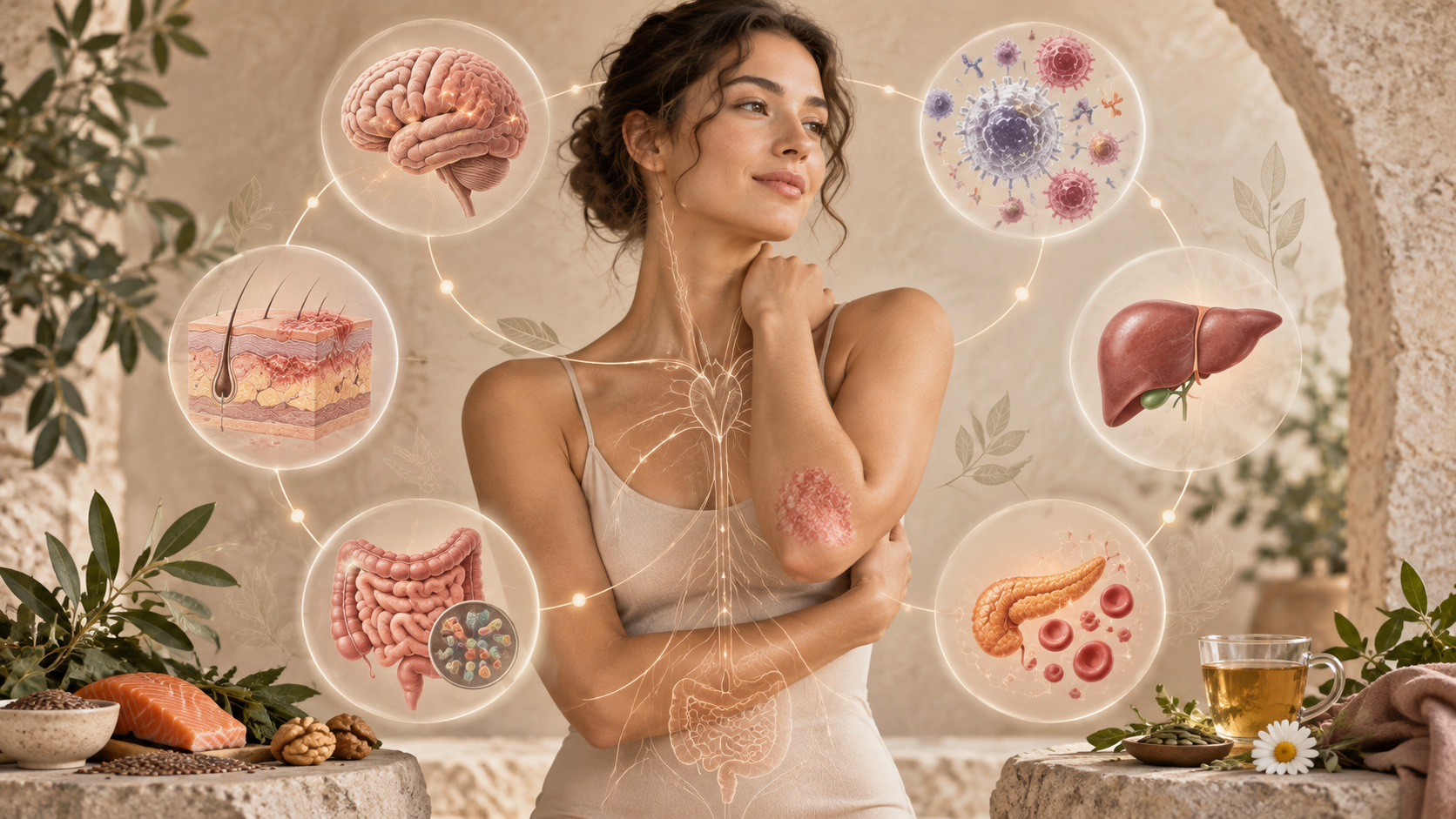
The plaques may appear on the skin, but the biological processes influencing them can involve much more: immune regulation, gut health, metabolic health, oxidative stress, stress physiology, nutrition and lifestyle.
That does not mean psoriasis has one hidden "root cause" waiting to be discovered. It is a complex, multifactorial condition.
What it does mean is that looking beyond the skin can sometimes reveal modifiable factors worth supporting alongside appropriate dermatological care.
What Actually Happens in Psoriasis?
Normally, skin cells develop and move towards the surface in a controlled process.
In psoriasis, immune cells become activated and produce inflammatory messengers including IL-17, IL-22 and TNF-α. These signals stimulate keratinocytes to proliferate more rapidly and produce further inflammatory signals.
The result is essentially a self-perpetuating cycle: immune activation → inflammatory cytokines → accelerated skin-cell growth → further immune activation.
This immune–keratinocyte interaction contributes to the formation of chronic psoriatic plaques.
Genetics matter too. Psoriasis is a polygenic condition, meaning that multiple genetic variants can influence susceptibility rather than there being one single “psoriasis gene.” The strongest association is with the PSORS1 region, particularly the HLA-C*06:02 allele, which has been linked with psoriasis susceptibility and, in some studies, greater disease severity. Other variants may affect inflammatory signalling, antigen processing and skin-barrier function, including genes such as CARD14, ERAP1 and CDSN. But genetic susceptibility does not necessarily determine exactly when or how severely the condition will develop. Environmental and physiological factors can influence whether the disease appears or flares.
That is where the wider picture becomes particularly interesting.
1. The Gut–Skin Connection
The gut microbiome is increasingly being studied in relation to psoriasis.
Research has identified differences in the gut microbiota of people with psoriasis, including reduced levels of some beneficial short-chain-fatty-acid-producing bacteria such as Faecalibacterium prausnitzii, alongside changes in other bacterial populations.
Why might this matter?
The intestinal microbiome helps regulate immune tolerance, intestinal barrier integrity and the production of metabolites such as short-chain fatty acids (SCFAs).
When this ecosystem becomes disrupted, several processes may occur:
- intestinal permeability may increase
- beneficial microbial metabolites may decrease
- inflammatory microbial products such as lipopolysaccharides may enter circulation more readily
- T-regulatory immune activity may become impaired
- inflammatory pathways including IL-23/Th17 may become more active
These mechanisms form part of what researchers call the gut–skin axis.
For some people with psoriasis, supporting gut health may be one part of a broader strategy to help reduce inflammatory burden and support overall disease management.
If someone also experiences persistent bloating, altered bowel movements, abdominal discomfort or other gastrointestinal symptoms, investigating gut health may be particularly relevant rather than treating it as an unrelated issue.
2. Metabolic Health and Psoriasis
One of the most important parts of psoriasis that often receives less attention is its relationship with metabolic health.
Psoriasis is associated with conditions including:
- insulin resistance and diabetes
- hypertension
- cardiovascular disease
- metabolic dysfunction-associated fatty liver disease
- obesity
- psoriatic arthritis
This is not simply because these conditions happen to occur together.
Adipose tissue is metabolically active.
As excess adipose tissue expands, it can contribute to chronic low-grade inflammation through changes in adipokines, increased free fatty acids and inflammatory cytokines such as IL-6 and TNF-α. Higher BMI has also been associated with greater psoriasis severity.
There is even a concept known as the "psoriatic march" — the idea that chronic systemic inflammation may promote insulin resistance and endothelial dysfunction and ultimately contribute to increased cardiovascular risk.
So when working with psoriasis, I would rarely look only at the skin.
Blood glucose regulation, waist circumference, lipid profile, liver health, blood pressure and overall metabolic health can form an important part of the bigger picture.
3. The Gut–Liver–Skin Axis
The liver is another interesting piece of the psoriasis picture.
Research suggests a bidirectional relationship between psoriasis and metabolic liver dysfunction.
Inflammatory mediators released in psoriasis may contribute to hepatic inflammation. At the same time, liver-derived inflammatory signals including CRP and IL-6 may contribute to systemic inflammatory activity.
Gut-derived endotoxins may provide another connection, creating a possible gut–liver–skin axis.
Again, this does not mean psoriasis is caused by a "toxic liver."
It means that liver health, metabolic health, intestinal health and systemic inflammation are interconnected physiological systems.
4. Stress Really Can Influence the Skin
People with psoriasis often notice something very clearly: their skin gets worse when life gets stressful.
This is not "all in your head."
Psychological stress activates the hypothalamic–pituitary–adrenal (HPA) axis and sympathetic nervous system.
With chronic stress, cortisol regulation may become disrupted and inflammatory control may become less effective. Stress-related signalling can also increase neuropeptides such as substance P and promote neurogenic inflammation in the skin.
This can create a difficult cycle: stress → inflammatory signalling → skin flare → psychological distress → more stress.
Which is why stress management should not be presented to someone with psoriasis as simply: "Try to relax."
The goal is to improve nervous-system regulation and resilience.
Depending on the individual, this might include regular physical activity, meditation, mindfulness, breathing practices, sleep support and vagus nerve stimulation techniques as part of a broader strategy to reduce chronic physiological stress and support nervous-system regulation.
Evidence for direct improvements in psoriasis remains variable, and psoriasis-specific evidence for vagus nerve stimulation is still limited, but these approaches may support psychological wellbeing and potentially influence inflammatory pathways involved in disease management.
5. Oxidative Stress
Psoriasis is also associated with increased oxidative stress.
Oxidative stress occurs when the production of reactive oxygen species exceeds the body's antioxidant defence capacity.
In psoriasis, reduced antioxidant defence and increased oxidative damage may further stimulate inflammatory signalling pathways including NF-κB and MAPK, helping maintain the inflammatory cycle.
This is one reason diet quality matters.
Rather than searching for one miracle "anti-inflammatory" food, I prefer to look at the overall dietary pattern:
- How many vegetables are being eaten?
- How much colour and diversity?
- Are omega-3-rich foods included regularly?
- How much of the diet comes from ultra-processed foods?
- Is alcohol frequent?
- Is fibre intake adequate?
This is far more meaningful than adding one antioxidant supplement to an otherwise poor dietary pattern.
6. Nutrient Status Matters — But More Supplements Are Not Always Better
People with psoriasis have been reported to have lower levels of nutrients involved in immune regulation, antioxidant protection and skin health, including vitamin D, zinc, selenium, omega-3 fatty acids and several B vitamins.
But that does not mean everyone with psoriasis should automatically supplement them.
The better question is: What does this individual actually need?
Vitamin D is a good example.
Vitamin D participates in immune regulation and keratinocyte differentiation, and correcting deficiency may be beneficial. But very high doses are not automatically better and can cause harm, so supplementation should ideally be guided by serum 25(OH)D levels.
Omega-3 fatty acids also have promising evidence. Clinical trials and a meta-analysis reported improvements in outcomes including PASI, erythema and scaling, although study protocols and doses varied.
Curcumin, selenium, CoQ10 and probiotics have also been investigated, but the quality and strength of evidence differs between interventions.
For probiotics in particular, some human trials have shown improvements in psoriasis severity and inflammatory markers, but there is no single universal probiotic protocol suitable for everyone. Different studies used different strains and protocols.
This is exactly why I do not believe in giving everyone with the same diagnosis the same supplement protocol.
Where gut involvement is suspected, I may also consider comprehensive stool analysis to better understand the individual microbiome pattern, identify dysbiosis or other relevant findings, and use that information to guide a more personalised strategy.
7. Do You Need to Remove Gluten?
Not necessarily.
This is one area where nutrition advice around psoriasis can become unnecessarily restrictive.
A gluten-free diet appears most relevant in people with confirmed gluten sensitivity or positive antigliadin antibodies.
In one study, psoriasis improved following a gluten-free diet in antibody-positive participants, whereas antibody-negative participants did not experience the same benefit.
So: psoriasis ≠ automatically gluten-free.
If there are digestive symptoms, coeliac disease, positive markers or a strong clinical suspicion of gluten sensitivity, investigation may make sense.
But removing multiple foods "just in case" can make a diet unnecessarily restrictive without addressing what is actually contributing to the individual's health picture.
Nutrition and Natural Support
There is no single "psoriasis diet."
Nutrition should support — not replace — appropriate medical care, and the most useful approach is usually personalised around the individual's inflammatory, metabolic and digestive picture.
A Mediterranean-style diet is one of the strongest foundations.
Think extra virgin olive oil, vegetables, berries and fruit, herbs, legumes, nuts, seeds, fish, adequate fibre and fewer ultra-processed foods.
Greater adherence to a Mediterranean diet has been associated with lower psoriasis severity, while a randomised trial also demonstrated improvement in PASI and HbA1c after 16 weeks.
A gluten-free diet may be useful in selected individuals, particularly where coeliac disease or gluten sensitivity is present, but it should not automatically become part of every psoriasis protocol.
For people who are overweight, improving metabolic health and achieving sustainable weight reduction may also help reduce psoriasis severity and improve treatment response.
Targeted supplements may also have a role. Evidence is most promising for nutrients and compounds such as vitamin D, omega-3 fatty acids, curcumin, selected probiotics, selenium and CoQ10, although the strength of evidence varies and supplementation should be individualised.
For me, the key is not to create a long "psoriasis supplement list," but to understand which areas actually need support — inflammation, nutrient status, gut health, metabolic health or oxidative stress — and then build the strategy around that person.
Other Triggers Worth Looking At
Different people may notice very different triggers.
Known or proposed factors associated with psoriasis development or exacerbation include infections, certain medications, skin injury, smoking, alcohol, obesity and psychological stress.
For example, streptococcal infection is a well-established trigger for guttate psoriasis.
Skin trauma can trigger new lesions at the site of injury — known as the Koebner phenomenon.
Smoking may worsen severity and treatment responsiveness.
Alcohol has also been associated with more severe disease and poorer treatment response.
This is why two people with "psoriasis" may need very different nutritional and lifestyle strategies.
What I Would Look At in Nutritional Therapy
I do not start with: "You have psoriasis, so here is the psoriasis protocol."
I start with the person.
We look at the whole clinical picture, including:
- Gut health: bloating, bowel movements, infections, microbiome disruption and intestinal symptoms.
- Metabolic health: glucose regulation, weight, lipids, cardiovascular risk and liver health.
- Inflammatory burden: diet, alcohol, smoking, chronic inflammatory conditions and lifestyle.
- Nutrient status: particularly where deficiencies or dietary insufficiencies are suspected.
- Stress and sleep: chronic stress load, nervous-system regulation and sleep quality.
- Dietary pattern: rather than simply compiling a list of foods to avoid.
- Medication and medical treatment: nutritional therapy should work safely alongside conventional psoriasis management, not compete with it.
Functional Testing
Functional testing can sometimes help identify factors contributing to the wider inflammatory picture in psoriasis and make recommendations more personalised.
Depending on the individual, this may include:
- Comprehensive stool analysis to assess dysbiosis, microbial balance and intestinal inflammation, particularly where digestive symptoms are present.
- Gluten or coeliac-related testing where sensitivity is suspected, rather than automatically recommending a gluten-free diet.
- Cortisol testing where chronic stress, poor sleep or circadian disruption may be contributing.
- Micronutrient and fatty-acid testing, including vitamin D, zinc, selenium, B vitamins and omega-3 status, where deficiencies are suspected.
The goal is not to run every test, but to choose testing based on symptoms, history and what would genuinely change the strategy.
The Bigger Picture
Psoriasis reminds us why treating symptoms in isolation can sometimes miss important information.
The skin is part of a much larger biological network.
Gut ↔ immune system ↔ metabolism ↔ liver ↔ nervous system ↔ skin
That does not mean every pathway needs "fixing."
And it certainly does not mean someone with psoriasis caused their condition through the wrong diet or lifestyle.
It means that once the diagnosis is medically managed, we can ask a more useful question: What factors may be contributing to this person's inflammatory load — and which of them can realistically be changed?
For one person, the priority may be metabolic health. For another, digestive dysfunction. For someone else, chronic stress, poor sleep or nutritional deficiencies. Often, several pieces overlap.
And that is where personalised nutritional therapy can be valuable: not by promising to "cure psoriasis naturally," but by supporting the wider physiology surrounding the condition.
Working With Psoriasis
If you have psoriasis and want to explore your nutrition and health from a wider perspective, nutritional therapy can help identify patterns across your symptoms, diet, digestive health, lifestyle, stress, nutrient status and relevant test results.
I use an individualised approach rather than standard psoriasis diets or generic supplement protocols.
Online consultations are available worldwide in English, Russian and Latvian.
Nutrition and lifestyle support should complement, not replace, medical assessment and treatment for psoriasis. Always discuss medication changes and significant symptoms with your doctor or dermatologist.
With love, Lana xx
This article is based on academic research and scientific publications. I used evidence covering the immune mechanisms of psoriasis, the microbiome, metabolic health, nutrition and lifestyle. The reference list is quite extensive, so I chose not to overload the article with citations, but I’m happy to provide the full list of references on request.